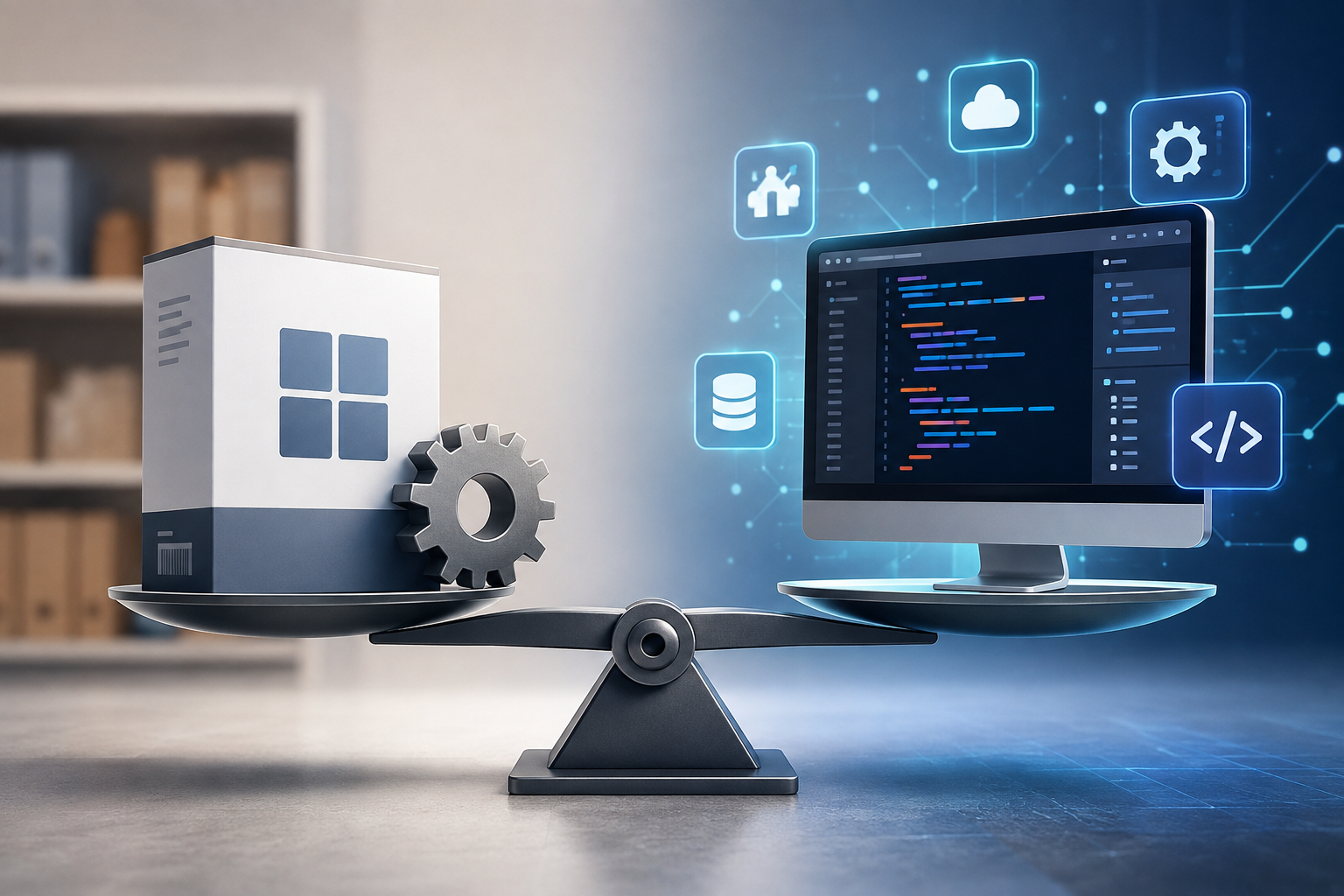

As businesses grow, technology becomes more than just a support function—it becomes an essential part of daily operations, customer experience, data management, and long-term strategy. Choosing the right software solution can therefore have a significant impact on how efficiently a company scales.
One of the most important technology decisions businesses face is Custom Software vs Off-the-Shelf software. Should a company invest in a solution built specifically around its processes, or should it choose an already-developed software product that can be deployed quickly?
There is no universal answer. Off-the-shelf software can be an excellent choice for businesses that need standard features quickly and affordably. Custom software, however, can provide greater flexibility when a company has unique processes, complex integrations, or ambitious growth plans.
At Claw Development, businesses can explore customized digital solutions designed around specific operational requirements. Claw Development provides software development, website development, application development, e-commerce, and other digital services for businesses looking to improve their technology infrastructure.
This guide explores Custom Software vs Off-the-Shelf solutions, their advantages and disadvantages, scalability, costs, flexibility, integrations, security, and the situations in which each option makes the most sense.
What Is Off-the-Shelf Software?
When comparing Custom Software vs. Off-the-Shelf solutions, it is important to first understand what off-the-shelf software offers. Off-the-shelf software is a pre-built software product designed to serve a broad group of businesses or users. Instead of being developed specifically for one company, it comes with standardized features, tools, and workflows.
Examples include accounting software, customer relationship management (CRM) platforms, inventory management systems, project management tools, communication platforms, and e-commerce solutions.
The biggest advantage of off-the-shelf software is speed and convenience. A business can purchase or subscribe to the software, configure basic settings, train employees, and start using it relatively quickly. This makes it a practical option for small businesses with straightforward and commonly used requirements.
What Is Custom Software?
Custom software is developed specifically for a particular business, industry, workflow, or operational requirement.
Instead of asking a company to change its processes to fit an existing application, custom development allows the software to be designed around the company’s processes.
For example, imagine an online food and meat business that needs a system connecting:
- Online orders
- Product inventory
- Delivery management
- Customer accounts
- Payment processing
- Supplier information
- Order tracking
- B2B orders
- Customer notifications
- Business analytics
A generic platform may handle some of these functions, but the company may eventually require custom workflows and integrations.
A custom solution can be developed around those requirements.
This approach is particularly useful for companies whose competitive advantage depends on specialized processes.
Custom Software vs Off-the-Shelf: Key Difference
The fundamental difference is flexibility.
Off-the-shelf software provides businesses with an existing framework. Custom software provides a framework that can be designed and evolved around the business.
Here is a simple comparison:
| Feature | Custom Software | Off-the-Shelf Software |
|---|---|---|
| Development | Built specifically for the business | Pre-built for many users |
| Initial Cost | Usually higher | Usually lower |
| Deployment | Takes more time | Usually faster |
| Customization | Very high | Limited to available options |
| Scalability | Designed around business growth | Depends on vendor and plan |
| Integrations | Can be specifically developed | Limited to supported integrations |
| User Experience | Designed around business workflows | Standardized |
| Maintenance | Business-specific | Usually vendor-managed |
| Competitive Advantage | Potentially high | Generally limited |
| Long-Term Flexibility | High | Moderate to low |
| Vendor Dependency | Can be reduced | Often higher |
| Feature Control | Greater | Controlled by vendor |
The right choice depends on the company’s current needs and future plans.
Why Scalability Matters in Software
Scalability means the ability of a software system to handle increasing workloads without becoming inefficient, unreliable, or excessively expensive.
Growth can happen in several ways.
A company may have:
- More customers
- More employees
- More transactions
- More products
- More locations
- More data
- More integrations
- More users
- More complex workflows
Software that works perfectly for 20 employees may become inefficient for 200 employees.
Similarly, a platform that handles a few hundred monthly transactions may struggle when the business reaches thousands or millions.
Therefore, scalability should not simply mean “can I add more users?”
It should also mean:
Can this software evolve as my business model evolves?
That is where the comparison between Custom Software vs Off-the-Shelf becomes particularly important.
How Off-the-Shelf Software Supports Growth
Off-the-shelf software can absolutely scale.
Many established software vendors provide different plans for startups, small businesses, mid-sized organizations, and enterprises.
Businesses can often increase:
- Number of users
- Storage
- Transactions
- Features
- Automation
- Support levels
- Integration capabilities
This makes off-the-shelf software attractive during the early stages of growth.
For example, a startup may not need a sophisticated custom CRM. A standard CRM could provide everything necessary to manage initial customers and sales.
The problem appears when the company’s requirements become increasingly specialized.
A business may want a workflow that the software does not support.
It might need a custom dashboard, unusual approval process, specialized reporting system, or proprietary integration.
At that point, the company may have to depend on workarounds, third-party plugins, or additional software.
Over time, this can create complexity.
How Custom Software Supports Growth
Custom software can be designed with scalability as a core development objective.
Developers can create the architecture around expected business requirements and future expansion.
For example, a growing e-commerce company could begin with:
Phase 1: Product catalog + shopping cart
Then expand to:
Phase 2: Customer accounts + payment integration
Then:
Phase 3: Inventory + logistics integration
Then:
Phase 4: Mobile application + loyalty system
Then:
Phase 5: Business intelligence + automation
Instead of replacing the entire system every time the business evolves, the software can potentially be extended.
Claw Development specifically highlights custom software, software integration, maintenance, and support as part of its software development capabilities. Its development services are intended to help businesses build solutions around their operational requirements.
You can learn more about Claw Development’s software and website development services.
Custom Software vs Off-the-Shelf: Cost Considerations
Cost is often the first factor businesses consider.
Off-the-shelf software generally has a lower initial cost because development costs are distributed across many customers.
Businesses may pay through:
- Monthly subscriptions
- Annual subscriptions
- Licensing fees
- User-based pricing
- Feature-based plans
Custom software usually requires a larger initial investment because the system is developed specifically for the organization.
However, comparing only the initial cost can be misleading.
Businesses should consider the total cost of ownership.
This may include:
- Subscription fees
- Additional user costs
- Plugin costs
- Integration costs
- Customization fees
- Migration expenses
- Maintenance
- Training
- Vendor lock-in
- Future replacement costs
A cheaper software solution today may become more expensive over several years if the business constantly needs additional tools and workarounds.
Conversely, custom software may require a significant upfront investment but provide greater control over the long term.
Flexibility and Customization
This is one of the strongest advantages of custom software.
Every organization has unique workflows.
Consider an online meat delivery business such as Zresh. Its website offers multiple categories including chicken, mutton, fish, prawns, eggs, and combination products. The platform also presents individual products such as Chicken Breast Boneless and Mutton Boneless, along with other product categories.
A growing business operating across multiple product categories could eventually require specialized systems for inventory, order processing, delivery, customer segmentation, and B2B supply.
A standardized platform may handle basic e-commerce requirements, but a custom application could be designed around the company’s specific operational model.
This doesn’t mean every business needs custom software.
It means businesses with unique workflows should carefully evaluate whether standardized software will continue meeting their requirements.
Integrations: A Major Scalability Factor
Modern businesses rarely use one software application.
A typical organization may use:
- CRM
- ERP
- Accounting software
- Payment gateway
- E-commerce platform
- Inventory management
- Marketing automation
- Logistics software
- Analytics
- Customer support tools
The ability to connect these systems becomes increasingly important as a business grows.
Off-the-shelf software may provide APIs and integrations, but businesses are limited to the integrations supported by the provider.
Custom software can be developed specifically to connect different systems.
For example, an e-commerce business could connect its website with inventory, payment processing, delivery management, customer notifications, and analytics.
Claw Development also provides software integration services because businesses often need internal and external systems to communicate effectively.
Security Considerations
Security is another important factor when comparing Custom Software vs Off-the-Shelf solutions.
Established off-the-shelf software providers may invest heavily in security, infrastructure, backups, monitoring, and compliance.
This can make standardized software attractive for businesses that don’t have large internal technology teams.
Custom software, however, allows security controls to be designed around the organization’s requirements.
Developers can implement:
- Role-based access
- Authentication systems
- Encryption
- Audit logs
- Access controls
- Secure APIs
- Data validation
- Backup strategies
However, custom software is not automatically more secure.
Security depends on how the system is designed, developed, tested, deployed, and maintained.
A poorly developed custom application can create significant security risks.
Therefore, businesses should work with experienced developers and include security throughout the development lifecycle.
User Experience and Productivity
Software should make employees more productive—not force them to spend additional time working around limitations.
Off-the-shelf platforms generally provide standardized interfaces.
That can be beneficial because employees may already be familiar with the software.
Custom software can instead be designed around actual employee workflows.
For example, if employees repeatedly perform the same five steps every time an order is processed, a custom system could automate or simplify those steps.
This can reduce:
- Manual data entry
- Duplicate work
- Human errors
- Training requirements
- Process delays
Better workflows can ultimately improve operational efficiency.
When Off-the-Shelf Software Is the Better Choice
Custom software isn’t always the right solution.
Off-the-shelf software may be better when:
1. Your Requirements Are Standard
If your business needs common functions such as accounting, email marketing, basic CRM, or project management, a standard platform may be sufficient.
2. You Need a Fast Deployment
Businesses that need software immediately may prefer an existing platform.
3. Your Budget Is Limited
Startups and small businesses may benefit from lower initial costs.
4. You Don’t Need Extensive Customization
If the software already matches 80–90% of your requirements, customization may not provide enough additional value to justify development costs.
5. You Want Vendor Support
Established SaaS providers often offer documentation, customer support, updates, and infrastructure management.
When Custom Software Is the Better Choice
Custom development becomes more attractive when:
1. Your Processes Are Unique
If your business operates differently from competitors, standard software may not fit efficiently.
2. You Expect Rapid Growth
Businesses planning significant expansion should consider whether their technology can support increased users, transactions, and operational complexity.
3. Integrations Are Critical
If your software needs to communicate with multiple internal and external systems, custom development may provide greater flexibility.
4. Software Is Part of Your Competitive Advantage
If technology directly contributes to your unique business model, owning a customized platform can be strategically valuable.
5. Existing Software Creates Too Many Workarounds
When employees constantly use spreadsheets, manual processes, multiple plugins, and disconnected tools to compensate for software limitations, it may be time to consider a custom solution.
Custom Software vs Off-the-Shelf: Which Scales Better?
The answer depends on what “scale” means for your business.
If scalability simply means adding more users to a standard workflow, off-the-shelf software may work very well.
If scalability means adapting technology to new business models, locations, workflows, integrations, products, and customer experiences, custom software often provides greater flexibility.
The following framework can help:
| Business Requirement | Recommended Option |
| Basic accounting | Off-the-Shelf |
| Standard CRM | Off-the-Shelf |
| Basic project management | Off-the-Shelf |
| Simple business website | Off-the-Shelf |
| Unique business workflow | Custom |
| Complex integrations | Custom |
| Proprietary business process | Custom |
| Highly specialized dashboard | Custom |
| Advanced automation | Custom |
| Rapid startup deployment | Off-the-Shelf |
| Long-term technology ownership | Custom |
| Limited initial budget | Off-the-Shelf |
The key is not to automatically choose one option.
Instead, evaluate how closely the software aligns with your business strategy.
A Hybrid Approach Can Also Work
Businesses don’t always have to choose completely custom or completely standardized technology.
A hybrid approach can combine both.
For example, a company could use:
- Off-the-shelf accounting software
- Standard CRM
- Cloud communication tools
- Custom inventory platform
- Custom customer portal
- Custom business analytics dashboard
This approach allows companies to build custom technology only where it creates meaningful value.
For many growing organizations, this can be a practical strategy.
Why Businesses Should Plan Software Around the Future
One of the biggest mistakes businesses make is choosing software based only on current requirements.
Technology decisions should consider where the organization expects to be in three to five years.
Ask questions such as:
- How many users will we have?
- Will we expand into new locations?
- Will our product range increase?
- Will we need a mobile application?
- Will we need new integrations?
- Will our customer base grow significantly?
- Will we need advanced analytics?
- Will automation become important?
- Will we need B2B and B2C workflows?
- Will our current platform still support these requirements?
These questions can reveal whether a quick software solution is genuinely scalable.
How Claw Development Can Help
Choosing between custom and off-the-shelf software requires more than comparing features.
Businesses need to understand their workflows, technical requirements, future goals, integrations, security needs, budget, and expected growth.
Claw Development works with businesses on customized digital solutions, including software development, website development, mobile applications, e-commerce, UI/UX, and software integration.
Its software development services include custom software, personalized software, software integration, and maintenance and support.
For companies that need a technology platform designed around their processes, a professional development partner can help translate business requirements into a scalable digital solution.
You can also explore Claw Development’s application development services for web and mobile application requirements.
Final Verdict: Custom Software vs Off-the-Shelf
The Custom Software vs Off-the-Shelf debate isn’t really about which option is universally better.
It’s about which option is better for your business.
Off-the-shelf software is usually ideal when your requirements are standard, your budget is limited, and you need a solution quickly.
Custom software becomes more valuable when your processes are unique, your business is scaling rapidly, integrations are important, or technology is becoming a core part of your competitive advantage.
For example, an evolving e-commerce business such as Zresh operates across product categories including chicken, mutton, fish, prawns, eggs, and combos. As businesses with increasingly complex operations grow, technology may need to connect customer ordering, inventory, delivery, analytics, and other workflows.
Ultimately, the best software is not necessarily the one with the most features.
It is the one that supports your business today and has the flexibility to support where your business is going tomorrow.
For startups and smaller businesses, starting with off-the-shelf software can be a smart way to control costs and validate processes. As the organization grows and its requirements become more specialized, custom development can provide the flexibility needed for the next stage.
If your current software is creating limitations, increasing manual work, or preventing your business from implementing better processes, it may be time to evaluate a customized solution.
With the right technology strategy and development partner, software can become more than an operational tool—it can become a foundation for sustainable business growth.